Oh, oh—sociology professors say that “most of what we do for our kids at schools doesn’t matter”
Read this New York Times essay on why Parental Involvement Is Overrated and weep for all the time you spent helping your child become well-educated. It doesn’t help that
“most parents appear to be ineffective at helping their children at homework.”
Many a time my kids asked me to help them do math, which I really dreaded—not because I could not come up with the answer, but due to the constantly-changing way schools taught it. After being told many times that I got the right answer the wrong way and thus provided absolutely no help, I began bearing down on studying the latest-and-greatest math book first before working out the problem.
By the way, I made the student go through the materials with me—that made this an effective approach for parental mentoring, or so I thought. Now I wonder if I should’ve even bothered.
However, one time one of my daughters did say that my way of explaining a puzzling math problem made a lot more sense the either the teacher or the book. That’s one time out of hundred other times that my good deeds did not go unpunished, but like the single outstanding golf shot out of hundred bad ones in any-given round, I remember this fondly. 🙂
My Minnesota Twins fail on fantasy front
Supposedly hope springs eternal at the start of every baseball season, no matter how miserable the prospects for your home team. Sadly the statisticians at the Wall Street Journal burst that bubble by skewering my squad—saying yesterday that It’s Not a Fantasy, the Minnesota Twins Are Bad. Their “Roster Reality” ranking leaves the hapless Twinkies last. Fantasy team owners figured only 3 players rated a position in the first 276 drafted. That is bad.
Being a homer, when I did my draft I filled my last position with Byron Buxton—the number 1 prospect in all of Major League Baseball. Unfortunately if BB does make it up to Minnesota this year it will be after the Twins get eliminated from contention. On the bright side I expect that will again happen with plenty of games remaining to let the up-and-comers get in some good playing time.
By the way, the Twins rallied this afternoon with 2 runs in the 9th to win out over the hated White Sox and prevent them from a 3 game sweep. That’s a 1 game winning streak! Woohoo!
Experiments by Incan agronomists
Earlier this week I visited Machu Picchu in Peru, which features extensive terracing for crop-growing. Five-hundred years ago the Incans took full advantage of a uniquely temperate microclimate on sites like this along the border of the Amazon. First of all they engineered a drainage system out of rocks brought up from the river below. Then they covered it with dirt laboriously hauled from fertile plains at lower elevations. Next they evidently experimented on different crops at different levels to get the best interaction with varying temperatures each step of the way down from the peak. According to a team of agronomists and archeologists  from U Penn who reproduced the Incan farming conditions, yields of potatoes came in at two or even four times what would be expected. All this is quite impressive—building a self-sustaining city at nearly 8000 feet on a peak with only a few, small flat areas.
Design of experiments (DOE) most important for optimizing products, processes and analytical technologies
Posted by mark in design of experiments, Uncategorized on March 1, 2014
According to this February 2014 Special Report on Enabling Technologies two-thirds of BioProcess readers say that DOE makes the most impact on their analytical work.
“The promise of effective DOE is that the route of product and process development will speed up through more cost-effective experimentation, product improvement, and process optimization. Your ‘batting average’ will increase, and you will develop a competitive advantage in the process.”
–Ronald Snee
A lot to love in new release of software–v9 is mighty fine!
Posted by mark in design of experiments on February 7, 2014
Here’s a shout-out for Valentine’s Day that there’s a lot to love in the new release of Stat-Ease software-see the major improvements here http://www.statease.com/dx9.html#description. Consultant Wayne Adams put v9 to fun use by developing equations that produced the 3D response surface renderings of the heart and number 9. Geeks rule! (No offense, Wayne, I am one.)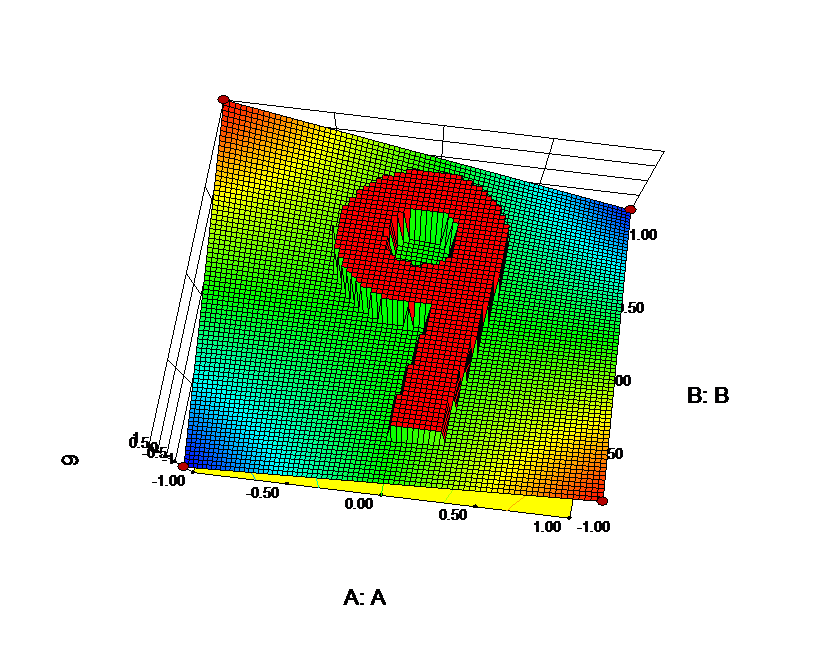

The rarest of birds—a reproducible result from a scientific study
Posted by mark in science, Uncategorized on February 3, 2014
In The New York Times new column Raw Data, science writer George Johnson laments experimenters
“ways of unknowingly smuggling one’s expectations into the results, like a message coaxed from a Ouija board.”
– Science Times, 1/21/14
This, of course, leads to irreproducible findings.
As a case in point, only 6 of 53 landmark papers about cancer found support in follow up studies, even with the help of the original scientists working in their own labs, according to an article in the Challenges in Irreproducible Research archive of Nature cited by Johnson.
That is discouraging but I am not surprised. I feel fairly sure that the any assertions of import get filtered very rigorously until only ones that reproduce reliably make it through.
The trick is to remain extremely skeptical of initial reports, especially those that get trumpeted and reverberate around the popular press and the internet. Evidently it is human nature to then presume that when an assertion is repeated often enough then it must be true, even though it has not yet been reproduced. Saying it’s so does not make it so.
Fun trivia on how many people it takes before chances are good that some or all share birthdays
Birthdays are in the news this month as the last of the Baby Boomers hit age 50—most notably Michelle Obama, but also my youngest sibling—brother Paul. A little game I’ve played with my larger statistics classes is to poll them for their birthday—month and day (one mustn’t dare to ask for the year). It turns out that with 23 people coming together at random the odds tilt in favor of at least two sharing this special date. Somehow that just does not seem likely but all one needs to do for working this out is calculate the probability of all having different birthdays, and then subtract the answer from 1.
By the way, it takes 88 people to achieve a good chance of 3 sharing a birthday.
This last statistic (88 for 3) comes from statistician Mario Cortina Borja in an article he wrote for the latest issue of Significance detailing “The strong birthday problem,” that is, not just one person but everybody in a group sharing a birthday with at least one other. By assuming that the birthdays follow a uniform distribution,* Borja worked out this complex problem. His results are somewhat counter-intuitive in the way probabilities decrease from 2 to 365 and rise thereafter—quickly gaining at 2000 and beyond. (Of course if only “me, myself and I” are gathered, that is, one person, the probability is technically 100 percent of a birthday match.) The answer to this strong birthday problem is 3064. At 4800 people there’s a 99% chance that everyone will share a birthday with another.
Borja suggests that it might be fun for a large celebration to award a prize to anyone with a lone birthday. If one won such a contest, it would really be a lonely experience.
*P.S. Borja provides the math for birthdays being distributed non-uniformly, but leaves it at that because the computational cost of solving it is “fiendish.” That’s OK because other statisticians who studied this problem found that the results change very little with deviations from the uniform distribution.
85 people have as much money as 3.5 billion
The 3.5 billion poorest people who account for half the world’s population can barely scrape up enough money to match the 85 wealthiest, according to the international relief organization Oxfam. I await verification on this statistic but, if true, it really boggles my mind.
Oxfam teed this attention-getting shot up in prep for the annual World Economic Forum in Davos, Switzerland this week. Let’s hope this convocation brings out the gnomes from Zurich who manage the gold from the hive of the weighty eighty-five. Perhaps a few coins might trickle out from the greedy to the needy.
Another round of three deaths now underway—triggered by the Professor
My favorite character in Gilligan’s Island–the Professor (aka Dr. Roy Hinkley)—passed away recently. 🙁 Who else will die, I wonder, because these always come in threes, or so it seems.
According to this newly-published study explaining “When Three Charms…, people gravitate to number 3. Being business school profs (Suzanne B. Shu of UCLA and Kurt A. Carlson of Georgetown U.), the authors focused on how to exploit this phenomenon for marketing purposes—their experiments pointing to the power of persuasion being optimized at three claims and no more—the fourth one pushes consumers over to being over-sold.
So be on guard from now on whenever someone tries to sell you on something by touting three reasons. 😉
Getting back to the morbid fascination with celebrity deaths, it may just be that this occurs from the natural tendency to conclude that three events in a row cannot happen just due to chance.
“You reach maximum streakiness at three events.”
– Kurt Carlson quoted by New York Times in 1/3/14 article about The Power of Three
Being somewhat savvy on statistics and generally a rational thinker, I know this is immensely overblown, but I cannot help but succumb to it, in particular when bad things come in bunches. My trick to put a halt to being unlucky is to resolve that whenever I’m hit by three unpleasant events then I watch for three good things to come. I suppose this is just the power of positive thinking overcoming the depressive impact of cursed karma, but this works for me—I encourage you to give it a try.
When the bunch of bad reaches three, that’s it for me–make that your mantra. 🙂
Must we randomize our experiment?
Posted by mark in design of experiments on December 31, 2013
In the early 1990s I spoke at an applied statistics conference attended by DOE gurus George Box and Stu Hunter. This was a time when Taguchi methods had taken hold, which engineers liked because the designs eschewed randomization in favor of ordering by convenience–with hardest-to-control factors changed only once during the experiment. I might have fallen for this as well, but in my early days in R&D I worked on a high-pressure hydrogenation unit that, due to risks of catastrophic explosion, had to be operated outdoors and well away from any other employees. (Being only a summer engineer it seemed that I was disposable.) Naturally the ambient conditions varied quite dramatically at times, particularly in the Fall season when I was under pressure (ha ha) to wrap up my project. Randomization of my experiment designs provided me insurance against the time-related lurking variables of temperate, humidity and wind.
I was trained to make runs at random and never questioned its importance. Thus I was really surprised when Taguchi disciples attending my talk picked on me for bothering to do so. But, thank goodness, Box had already addressed this in his 1989 report Must We Randomize Our Experiment. He advised that experimenters:
- Always randomize in those cases where it creates little inconvenience.
- When an experiment becomes impossible being subjected to randomization
- and you can safely assume your process is stable, that is, any chance-variations will be small compared to factor effects, then run it as you can in non-random order;
- but, if due to process variation, the results would be “useless and misleading” without randomization, abandon it and first work on stabilizing the process;
- or consider a split-plot design.
I am happy to say that Stat-Ease with the release of version 9 of its DOE programs now provides the tool for the compromise, as Box deems it, between randomizing or not, that is—split plots. For now it is geared to factorial designs, but that covers a lot of ground for dealing with hard-to-change factors such as oven temperature in a baking experiment.* Details on v9 Design-Expert® software can be found here http://www.statease.com/dx9.html along with a link to a 45-day free trial. Check it out!
*For a case study on a split-plot experiment that can be easily designed, assessed for power and readily analyzed with the newest version of Stat-Ease software, see this report by Bisgaard, et al (colleagues of Box).